
Form 5471 master guide: Form 5471 constructive ownership rules explained
How section 958 attribution rules determine CFC and U.S. shareholder status for Form 5471 filing, explained straight from the Internal Revenue Code. Part B of the Brolma Advisory Form 5471 Master Guide.
5471 GUIDE
7/14/20269 min read
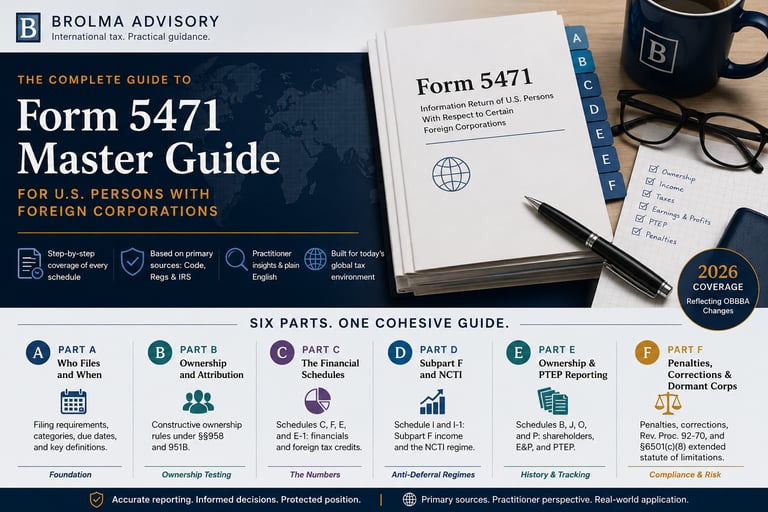

Form 5471 master guide, part b: Constructive ownership and CFC status
Every category described in Part A rests on two questions: is this person a U.S. shareholder, and is the foreign corporation a controlled foreign corporation. Neither question can be answered by looking at a cap table alone. The Internal Revenue Code treats stock as owned in three distinct ways, direct, indirect, and constructive, and the constructive ownership rules in particular can pull a person into CFC status through a family member, a partnership, or a corporate chain they may never have thought to check.
This part works through section 958 in full, then closes with the single most significant change to this area of the law in over a decade: the OBBBA’s restoration of section 958(b)(4) and the new anti-abuse rule at section 951B, both of which take effect for foreign corporation tax years beginning after December 31, 2025.
Direct ownership
Direct ownership is the simple case. Under section 958(a)(1)(A), stock is owned directly if it sits in the person’s own name.
Indirect ownership
Section 958(a)(2) covers stock owned through a chain of foreign entities. If a foreign corporation, foreign partnership, foreign trust, or foreign estate owns stock in another foreign corporation, that ownership is treated as belonging proportionately to the shareholders, partners, or beneficiaries above it. This creates a chain that can run through several tiers of foreign entities, but the chain generally stops at the first U.S. person it reaches. Any further attribution beyond that point is not tested under section 958(a) at all, it has to be tested separately under the constructive ownership rules of section 958(b), covered next.
A practical example: a U.S. corporation directly owns 75% of a foreign subsidiary, which in turn owns 80% of a second tier foreign subsidiary. The U.S. corporation indirectly owns 60% of the second tier entity (75% times 80%), and that entity is a CFC because more than 50% of it is owned, directly or indirectly, by a U.S. shareholder.
One important carve out sits inside this rule. For purposes of section 951A (the regime now called NCTI, covered in Part D) and anything that applies by reference to it, a domestic partnership is not treated as owning stock under section 958(a) at all. Instead, the domestic partnership is treated the same way a foreign partnership would be, and its partners are treated as the indirect owners in their own right. This matters when a U.S. LLC or partnership sits between a person and a foreign corporation, since it changes who is actually treated as the CFC’s shareholder for inclusion purposes.
Constructive ownership
Section 958(b) is where most of the complexity lives. It imports the general constructive ownership rules of section 318, but with several modifications specific to the international context, and it applies whenever the effect would be to treat a U.S. person as a U.S. shareholder, to treat someone as a related person under section 954(d)(3), to treat domestic corporation stock as owned by a U.S. shareholder of a CFC for section 956(c)(2) purposes, or to treat a foreign corporation as a CFC.
Family attribution. An individual is treated as owning stock owned by their spouse, children, grandchildren, and parents. Stock attributed this way cannot be attributed again to make a different family member the owner. Section 958(b)(1) narrows this: stock owned by a nonresident alien is not attributed to a U.S. citizen or resident family member. If a U.S. citizen’s parent is a nonresident alien who owns 100% of a foreign corporation, that stock is not attributed to the citizen for CFC or U.S. shareholder testing, purely because the parent falls outside the U.S. person definition. The one exception is section 956(c)(2), where this family attribution block does not apply.
Attribution from partnerships, estates, and trusts. Stock owned by a partnership or estate is generally treated as owned proportionately by the partners or beneficiaries, and stock owned by a trust is allocated to beneficiaries based on their actuarial interest, with grantor trust stock attributed straight to the grantor. Section 958(b)(2) adds a threshold rule on top of this: if a partnership, estate, or trust owns more than 50% of the voting power of a corporation’s voting stock, it is treated as owning all of that voting stock, not just its proportionate share.
Attribution from corporations. The general rule attributes a corporation’s stock to any shareholder owning 50% or more of its value. Section 958(b)(3) lowers that threshold specifically for this context: a shareholder owning just 10% or more of the value of a corporation is treated as proportionately owning the stock that corporation holds in another company. Separately, section 958(b)(2) also applies the same more than 50% voting power rule to corporations that it applies to partnerships, estates, and trusts: a corporation owning more than 50% of another corporation’s voting stock is treated as owning all of it.
Downward attribution. This runs the other direction, from an owner to the entities below them. A partner or beneficiary’s stock is treated as owned by the partnership or estate itself. A person owning 50% or more of a corporation’s value has their stock treated as owned by that corporation. This is the mechanism that, combined with the historical repeal of section 958(b)(4) discussed below, caused so much unintended CFC exposure between 2018 and 2025.
Operating rules. Where stock could be attributed under more than one rule, it is treated as owned under whichever rule produces the largest percentage. Stock attributed through family attribution cannot be re-attributed to another family member, and stock attributed downward cannot be re-attributed upward to create a different constructive owner. These stacking limits matter in multi tier structures, where it becomes tempting to chain attribution rules further than the regulations actually allow.
The definitions that everything else depends on
U.S. shareholder (section 951(b)): a U.S. person who owns, directly, indirectly, or constructively, 10% or more of the combined voting power or total value of a foreign corporation’s stock.
Controlled foreign corporation (section 957(a)): a foreign corporation where U.S. shareholders collectively own, directly, indirectly, or constructively, more than 50% of combined voting power or total value, on any day of the corporation’s tax year.
Specified foreign corporation (section 965(e)): any CFC, plus any foreign corporation with at least one domestic corporate U.S. shareholder, excluding a passive foreign investment company that is not otherwise a CFC.
Notice that the CFC test uses “more than 50%” while the U.S. shareholder test uses “10% or more.” A person can be a U.S. shareholder of a foreign corporation that is not a CFC, if the collective U.S. ownership across all U.S. shareholders never crosses 50%. Category 5 filing obligations only arise once both tests are satisfied at the same time.
The section 958(b)(4) story: why this section has a history worth knowing
Before 2018, section 958(b)(4) blocked downward attribution specifically where it would treat a U.S. person as owning stock actually held by a foreign person. This kept foreign parented groups from accidentally turning their own foreign subsidiaries into CFCs just because they also happened to own a U.S. subsidiary.
The Tax Cuts and Jobs Act repealed section 958(b)(4) in 2017, effective for foreign corporation tax years beginning after 2017. The repeal was intended to target a narrow category of inversion transactions, but the actual statutory language reached much further. A U.S. subsidiary of a foreign parent could suddenly be treated as constructively owning its foreign parent’s other subsidiaries, turning brother sister foreign entities into CFCs and their unrelated minority U.S. investors into unexpected Category 1 or Category 5 filers, with no real change in control on the ground.
The IRS responded with Notice 2018-13 and, more substantively, Rev. Proc. 2019-40, which created relief for exactly this situation. This is the origin of the Category 1b, 1c, 5b, and 5c sub types introduced in Part A: they exist specifically to reduce the filing burden on U.S. persons who only became U.S. shareholders or related parties of a CFC because of downward attribution from a foreign person, not through any real ownership or control. The revenue procedure defines a foreign controlled CFC as exactly this scenario: a foreign corporation that is a CFC, but would not be one if you removed the downward attribution rules of section 318(a)(3)(A) through (C) from the analysis.
What changed under OBBBA
The One Big Beautiful Bill Act reversed this seven year old problem directly. Section 958(b)(4) is restored, effective for tax years of foreign corporations beginning after December 31, 2025, and for the tax years of U.S. persons in which or with which those foreign corporation tax years end. Downward attribution from a foreign person to a U.S. person, for purposes of determining U.S. shareholder and CFC status, no longer applies going forward. A foreign corporation is not treated as a CFC, and a U.S. person is not treated as its U.S. shareholder, purely because of stock a foreign parent or foreign relative happens to hold.
Congress paired this restoration with a new, narrower anti-abuse provision at section 951B, aimed specifically at the inversion style transactions the original 2017 repeal was trying to stop. Section 951B applies Subpart F and NCTI inclusion rules to a “foreign controlled United States shareholder” (an FUSSH) of a “foreign controlled foreign corporation” (an FCFC), and it builds both terms on top of the ordinary U.S. shareholder and CFC definitions with two specific statutory modifications. First, the ownership bar is much higher: a U.S. person only qualifies as an FUSSH by owning more than 50% of the foreign corporation by vote or value, not the standard 10% U.S. shareholder threshold. Second, for purposes of this specific test, downward attribution from a foreign person still applies even though section 958(b)(4) has otherwise been restored, meaning FUSSH and FCFC status are tested as if the restoration never happened. This is a targeted rule aimed at real control situations, not a wholesale reinstatement of the old downward attribution problem, but exactly how the two modifications interact in edge cases, particularly a mid year change in ownership, is not yet addressed by regulations.
There is a practical timing wrinkle worth flagging for any client with a non calendar year foreign corporation. Because the restoration applies to tax years of the foreign corporation beginning after December 31, 2025, take a foreign corporation whose tax year runs from July 1 to June 30. Its tax year that began July 1, 2025 started before the cutoff, so that entire year, through June 30, 2026, is still tested under the old repealed rule. Only its next tax year, beginning July 1, 2026, picks up the restored section 958(b)(4) treatment. The change is not retroactive, and it does not automatically clean up prior year exposure. Anyone who picked up an unwanted Category 1c or 5c filing obligation for 2018 through 2025 under the old rule still had that obligation for those years.
A word of caution on this section specifically: section 951B is new statutory law with no Treasury regulations or Form 5471 instruction updates behind it yet. The mechanics described here come directly from the statute itself. Treat this area as one to monitor closely for forthcoming guidance rather than a settled, fully mapped set of rules the way sections 957 and 951(b) are.
Coming up in part c
Part c moves from ownership definitions into the numbers themselves: Schedules C, F, E, and E-1, covering the foreign corporation’s income statement, balance sheet, and the foreign tax credit mechanics that connect back to the U.S. shareholder’s own return.
Sources for this article: IRC §§318, 951(b), 951B, 953(c), 954(d)(3), 956(c)(2), 957(a), 958(a)-(b), 965(e); Treasury Regulations §§1.958-1, 1.958-2, 1.951A-1(e)(1); IRS LB&I Practice Unit, “IRC 958 Rules for Determining Stock Ownership” (DCN INT-C-252); Notice 2018-13, 2018-6 I.R.B. 341; Rev. Proc. 2019-40, 2019-43 I.R.B. 982; Tax Cuts and Jobs Act, Public Law 115-97, §14213 (2017); One Big Beautiful Bill Act, Public Law 119-21, §70353 and new IRC §951B (July 4, 2025).
Form 5471 master guide: complete IRS filing reference for 2026, by Brolma Advisory
A six part Form 5471 guide built entirely from IRS instructions, the Internal Revenue Code, and Treasury Regulations. Filing categories, CFC ownership, Subpart F, NCTI, penalties, and more.
Part A: Who must file and when
Part B: Constructive ownership and CFC status
Part C: The financial schedules
Form 5471 Navigator: CFC Filing Guide | Brolma Advisory
Work through the five Form 5471 filer categories for controlled foreign corporations, see which schedules apply, and what your filing position looks like.


About Brolma Advisory
Brolma Advisory is an accounting, tax, and financial advisory firm built for businesses and individuals whose situations do not fit standard templates. We work with international businesses establishing or operating in the United States, US companies expanding abroad, and complex businesses including SEC reporting and public company close support, multi-entity and intercompany structures, tech and SaaS platforms, subscription and recurring revenue models, and e-commerce and platform sellers. On the individual side, we advise UK and US professionals, founders, and investors navigating both tax systems, along with US expats living and working abroad.
What connects all of it is complexity that generic accounting was never built to handle. Cross border ownership, deferred revenue, multi-currency reporting, entities with non-US owners, cash and revenue that never quite line up. Brolma Advisory builds accounting and tax structures that reflect how these businesses actually work, so the numbers make sense and the compliance holds up wherever it is tested.
Disclaimer:
Content published by Brolma Advisory is provided for informational purposes only and reflects research, industry analysis, and our professional perspective. It does not constitute legal, tax, or accounting advice. Regulations vary by jurisdiction, and individual circumstances differ. Readers should seek advice from a qualified professional before making decisions that could affect their business.
See also our Disclaimer page
Brolma Advisory
Accounting built for complexity
Not legal advice, always verify with your Accountant
Email:
Contact us:
© 2025. Antravia LLC, trading as Brolma Advisory - All rights reserved.
| Disclaimer | Privacy Policy | Terms of Use |
contact@brolma.com
Brolma Advisory
941 W Morse Blvd suite 100
Winter Park
Florida
32789